Hi
http://metalfabsanantonio.com/imagination.php?fight=nys7efec261
reversibleraincoat@gmail.com
Sent from my iPhone

Saturday, April 25, 2015

Tuesday, March 24, 2015
Thursday, January 31, 2013
Moving!

This blog has a new home!
I've been thinking about and working on this move for some time now. (Like, a year.) Wordpress just seems to be more common, and I wanted to learn how to use that blogging platform. (I also could never get the layout quite right in blogger, and I'm picky that way.) I also kind of wanted a fresh slate and my own domain.
So, please update your bookmarks and feed readers to: http://www.libertyequalitygeology.com !
Sunday, February 26, 2012
Captain Kirk and Object Oriented Programming, According to my Dad
I’m taking a Java class right, and having a little bit of trouble wrapping my head around the concept of object-oriented programming and how to implement it. So, I asked my dad for some advice, and this is how he responded:
"Object oriented thinking:
Imagine a planet, any planet. How do you describe a planet? These are the properties.
The planet has it's own gravity,
It's own sky color,
It's own funny looking, sexy locals - if it is a 'star trek' type of planet
It's own monsters.
What do you do on the planet? These are the methods.
Look at the sky,
Chase the women
Run from the monsters
So Capt Kirk lands on Boiseity, what does he find?
Gravity - normal
Rainfall - dry
Local women - nice clean cut Mormons
Local monsters – chipmonks
These are the unique properties of the Boiseity planet.
Now Capt. Kirk lands on CapitolHillia, what does he find?
Gravity - .95 earth normal
Rainfall - wet
Local women - grunge
Local monsters – panhandlers
CapitolHillia and Boiseity are both unique objects of class Planet.”

Fighting aliens makes so much more sense than withdrawing funds from a bank account.
Hilarious, right?
Wednesday, February 22, 2012
Ten Things I Love About Studying Geology
There’s a wee bit of a geomeme going on about what one likes most about one’s geologic field of interest. It started with Erik Klemetti’s post on “10 Thing I Love About Volcanoes,” and was quickly followed up by Siim Sepp’s post on “The Top Ten Reasons I Love Sand,” Callan Bentley’s post on The Tope 10 Reasons I Love Structure,” Silver Fox’s post on “Top 10 Reasons I Love Detachment Faults,” Hollis’ post on “Top 10 Reasons I Love Wyoming Geology,” and then Garry Hayes's post on “10 Reasons I Love Teaching Geology At Community College.”
Since I’m a geo-baby, I thought I’d talk about what I love about being a geoscience student!
I originally studied classical literature, philosophy, math, and science at a liberal arts college. While that experience has deeply shaped me, the most important thing it taught me was what I really want to study – the world! Geology is the best way to study the world that I’ve found, so I happily switched majors!

1. Real facts.


11. New things to learn. Everyday.
Since I’m a geo-baby, I thought I’d talk about what I love about being a geoscience student!
I originally studied classical literature, philosophy, math, and science at a liberal arts college. While that experience has deeply shaped me, the most important thing it taught me was what I really want to study – the world! Geology is the best way to study the world that I’ve found, so I happily switched majors!

Woo, rocks! My excitement face shortly after switching majors.
I’m just getting into upper-division coursework, and I decided to take a geophysics major, so I have quite a challenge ahead of me! But I’m excited to have the opportunity to study so many cool things, for the following reasons:1. Real facts.
2. Whiteboards > ChalkboardsThe movement of Mars, over 16 years, according to the folks before Kepler.The Earth revolves around the Sun.
Atoms exist.
The “heavenly spheres” are the troposphere, the stratosphere, the mesosphere, and the thermosphere. Sometimes the magnetosphere and the galaxy come up. None of them play music, or have anything to do with the divine.
Promise.

Chalk dust gets everywhere: in your nose, in your hair, on your pants. It may look hip and old-school, but it’s kind of a pain.3. Arts & Crafts Time.
Whiteboards, on the other hand, only leave black smidges on your fingers.
Recently, I was talking to a computer science student about how much I like graphics. His response? “But I thought you were into, like, geology.”
But the geosciences are filled with pretty pictures! There are nifty geologic maps and psychedelic polarized thin sections. There are colorful charts and graphic graphs. And, of course, the “reference photos.”

Look at that rhyolite! Sunset for scale.
4. Interesting lectures.I love listening to people explain things I know nothing about! It’s a great way to explore the field, learn more about the world, and make connections to things I’m studying. I’m most comfortable when I’m a little bit confused.5. Fancy equipment.
6. Fieldwork.
Or not so fancy equipment.I can’t even properly pronounce magnetometer, but I’ve used one (briefly.) Seismometers are currently blowing my mind, and I’m really excited for the vibrating trucks while studying active seismology. I also love using fancy technology like remote sensing satellite data and excessive computing power. The toys are awesome.
Homework for a liberal arts major:7. The people are nice.
Homework for a geoscience major:
One of these will result in a Vitamin D deficiency.
The other will result in a cold beer.
Tough call, right?


Pretentious, me? Never.
Being pretentious is a prerequisite for a philosophy scholar. Sometimes, they’re lovely, fascinating people. Frequently, they’re mean as snakes, twice as funny looking, and think they’re the coolest thing to wear tight pants.
Geologists are good-natured, helpful, and handy in a pinch. Also, they’re generally gorgeous – the men are handsome and handy, the women are beautiful and highly competent. I think it’s all that Vitamin D.8. The scope.
Plus, it’s just tough to be pretentious while “examining the sagebrush.”
From isotopic changes in the range of parts per billion, to the rise of immense mountain chains hundreds of kilometers long; from the earliest creation of the planet, to the future movements of continents; from the relatively slow movement of water through a watershed, to dramatic pyroclastic deposition over the course of a few minutes; from the glacial moraine in my parent’s backyard, to Arizona-sized volcanoes on Mars – geology encompasses all of these.9. Real-life applications.
How is that not awesome, in the truest sense of the word?
I LOVE the thought that, someday, I’ll be qualified to search for oil, reconstruct the tectonic history of the planet, understand hydrological changes in caves, analyze earthquakes to see the structure of the planet, make discoveries about cryovolcanism on Enceladus, or help predict volcanic eruptions.
Or even just be able to pick up a rock from the river, and know what it is, and where it’s been. That’ll be pretty cool too!
10. The fine line between “work” and “vacation.”
Work:Exploring a’a lava at Craters of the Moon.


Doing cave monitoring for the BLM at Craters of the Moon.
Vacation:
Learning about multi-colored lava underground near Mt. St. Helens.

Examining glacial geology and learning about Idaho geology at Redfish Lake.
Bonus! 11. New things to learn. Everyday.
Today, I learned how to analyze stress and fracturing in rocks using a wacky thing called a “Mohr’s Circle Diagram.” Then I learned about constructing three-dimensional objects just using calculus. Then I learned how to make Java applets. Then I learned how to find different rock types via satellite. Then I came home and read about ocean islands and mantle plumes.
In one day. Who knows what crazy business we’re going to learn tomorrow?
I’m sure it’s going to be incredible.
Sunday, January 22, 2012
It's a Branch, It's a Pothole - no, it's an Earthquake!
For December’s Accretionary Wedge, (#41!) Ron Schott has asked us to describe the most significant or memorable geologic event we have personally experienced. The first thing that sprang to my mind was the 2001 Nisqually Earthquake.
In February of 2001, I was 13 years old. At that time, I was half-homeschooled – I took a couple classes at the junior high in the morning, and then my mum picked me up for some homeschooling. (Reality: I’d wait until she left on some lawyer-ly errand, and then make grilled cheese and watch Wheel of Fortune. What a rebel.)
On February 28, at 10:54 am, I had just been picked up from school, and we were driving in my mother’s 1870s powder-blue Camaro towards The Big Swoopy Hill. All of a sudden, the car swayed back and forth, the dashboard tilting up and down. It looked like that One Time My Dad Took the Car on the Potholed Forest Service Road Where People Go Mudding.
“Mum, do we have a flat?” I asked.
“No, I don’t think so. We might have run over a downed branch.” My mum looked in the rearview mirror. “Although I don’t see anything behind us…”
“Mum, look at the lady parked on the side of the road!”
“She’s getting back in her car, she’s ok.”
After we got back home, my mother worked on some legal briefs, and I worked on my report on deciduous trees. After an hour or so, the phone rang.
My mum picked it up. “Hello?”
“Are you ok? Is the house ok?” my dad asked, frantically.
“We’re fine… Are you?”
“There was an earthquake!”
We walked around the house, and, sure enough, some of the vases on top of the piano had shifted a little. The dishes had moved.
The next day at school, my classmates regaled me with tales of crawling under their plastic-topped desks, all the while imagining the back half of the portable buildings sinking into the ground. One girl even declared that she’d thought it was the Rapture.
I tried to explain our harrowing tale to them, but even my best retelling didn’t convince them it was cooler than the Rapture.
The 2001 Nisqually earthquake only rated a 6.8, with a depth of about 52km, and is an example of normal faulting in a subduction zone – the Juan de Fuca plate was bending (and stretching) as it was forced under the North American plate. This is possibly due to increased warmth near the mantle heating up the subducting plate, dehydrating it and making it more brittle - kind of like baked potato chips.
Luckily, only one person died (as the result of a heart-attack) and 407 people were injured. It did cause significant damage to roadways near the epicenter (in the Olympia and Nisqually area.)
Additionally, it caused significant damage to buildings both in Olympia and Seattle – including causing a large crack in the dome of the Washington State Capitol in Olympia.
It also damaged the Alaska Way Viaduct in Seattle, which led to a decade of plans, negotiations, and general strum und drang about replacing it, as well as this terrifying simulation. Apparently, they’ve now begun construction on a replacement. The earthquake resulted in $3.5 million in repairs to the viaduct, and construction of a replacement/refurbishment/tunnel/etc. is projected to cost $3.1 billion. It’s money well spent, I think, because that sucker looks like a car-sandwich just waiting to happen.
There were also spots of liquefaction and sand boils in both Olympia and Seattle. Liquefaction is pretty nifty, and luckily didn’t cause much damage in this earthquake. (Many portions of Seattle’s waterfront are built on fill – liquefaction could be a huge problem for those areas.)
While much of the liquefaction seems to have been little sand boils, it also invaded basements. Additionally, there was a large mudslide in the Renton area, which also did significant property damage.
I’m really glad that I was able to experience a medium-sized earthquake, without my family suffering any damages, and without the region suffering many deaths. I do still kind of wish we had realized it was an earthquake when it was occurring – that would have been so much more terrifying and exciting! But it was still a very memorable experience.
In addition to the websites linked through the above photos, here are some websites with information on the Nisqually earthquake:
Some Observations of Geotechnical Aspects of the February 28, 2001, Nisqually Earthquake in Olympia, South Seattle, and Tacoma, Washington
Geodetic Information from Central Washington University
The Nisqually Earthquake Information Clearinghouse, housed by the University of Washington
GPS Analysis of Olympia Quake from Rensselaer Polytechnic Institute
The Pacific Seismic Network's Nisqually Earthquake Page
USGS's Preliminary Earthquake Report
Washington State Department of Natural Resource's Nisqually Earthquake Page
Identifying the Rupture Plane of the 2001 Nisqually, Washington, Earthquake
A Video Taken Inside Microsoft During the Earthquake
KOMO News Broadcast from February 28, 2001
Car image: http://bit.ly/x4x9RL
This video made me laugh so hard I cried. It's ridiculous!
 |
| This is the seismograph from Wupatki, Arizona. There weren't many closer, and I quite liked how clearly the P-wave and S-wave showed up in this one. |
On February 28, at 10:54 am, I had just been picked up from school, and we were driving in my mother’s 1870s powder-blue Camaro towards The Big Swoopy Hill. All of a sudden, the car swayed back and forth, the dashboard tilting up and down. It looked like that One Time My Dad Took the Car on the Potholed Forest Service Road Where People Go Mudding.
“Mum, do we have a flat?” I asked.
“No, I don’t think so. We might have run over a downed branch.” My mum looked in the rearview mirror. “Although I don’t see anything behind us…”
“Mum, look at the lady parked on the side of the road!”
“She’s getting back in her car, she’s ok.”
After we got back home, my mother worked on some legal briefs, and I worked on my report on deciduous trees. After an hour or so, the phone rang.
My mum picked it up. “Hello?”
“Are you ok? Is the house ok?” my dad asked, frantically.
“We’re fine… Are you?”
“There was an earthquake!”
We walked around the house, and, sure enough, some of the vases on top of the piano had shifted a little. The dishes had moved.
The next day at school, my classmates regaled me with tales of crawling under their plastic-topped desks, all the while imagining the back half of the portable buildings sinking into the ground. One girl even declared that she’d thought it was the Rapture.
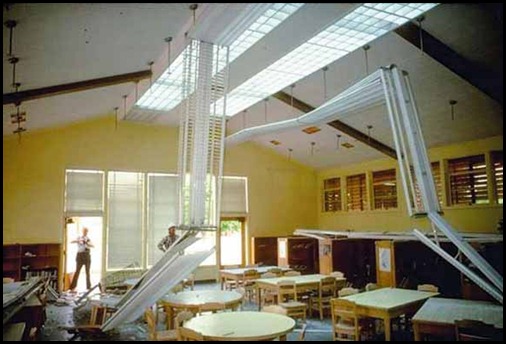 |
| This is from a school near Nisqually. Our school only had a couple lights fall down, and was otherwise fine. |
 |
| Well, I tried. |
 |
| A fault plane solution for the Nisqually earthquake. The little circles are dilatations, and the little stars are compression - so you can see how part of the plate extended, compressing the material to either side. |
 |
| A path near the State Capitol. One fellow looks depressed at the thought of all the work he's going to have to do. The other fellow looks like this is the coolest thing to ever happen - definitely a geologist. |
 |
| Highway 101 - nobody really uses the right lane, do they? |
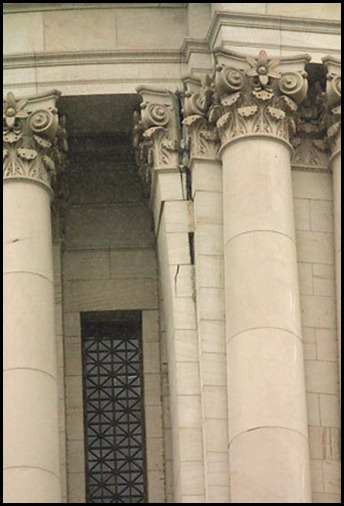 |
| The exterior of the State Capitol. You can see that some of the bricks are separating from the facade. The building was shut down for quite some time as it was examined for structural stability. |
 |
| Looters run rampant in downtown Seattle. These fellows actually just found a co-worker's purse amidst the wreckage of their van. |
 |
| "Pssh, I've got nine lives, I ain't scared." |
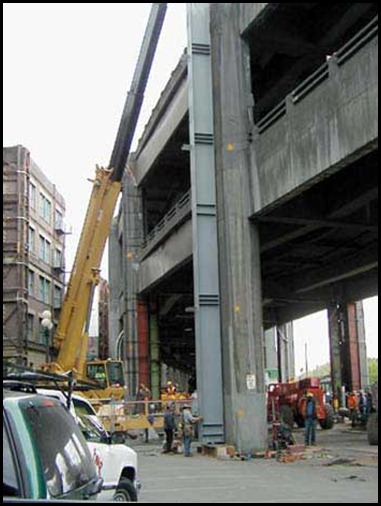 |
| Some fellows braving aftershocks to repair the Viaduct so people can tempt fate. |
 |
| A sand boil in Olympia. |
 |
| Worst sweeping job ever. |
In addition to the websites linked through the above photos, here are some websites with information on the Nisqually earthquake:
Some Observations of Geotechnical Aspects of the February 28, 2001, Nisqually Earthquake in Olympia, South Seattle, and Tacoma, Washington
Geodetic Information from Central Washington University
The Nisqually Earthquake Information Clearinghouse, housed by the University of Washington
GPS Analysis of Olympia Quake from Rensselaer Polytechnic Institute
The Pacific Seismic Network's Nisqually Earthquake Page
USGS's Preliminary Earthquake Report
Washington State Department of Natural Resource's Nisqually Earthquake Page
Identifying the Rupture Plane of the 2001 Nisqually, Washington, Earthquake
A Video Taken Inside Microsoft During the Earthquake
KOMO News Broadcast from February 28, 2001
Car image: http://bit.ly/x4x9RL
This video made me laugh so hard I cried. It's ridiculous!
Friday, November 25, 2011
Fall in West Idaho
In the past, I’ve waxed poetically (or, at least waxed on endlessly) about the beauty of the eastern Snake River Plain. But the more metropolitan western section is also quite lovely, especially in the fall!

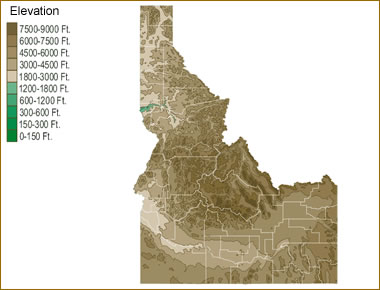
The whole western Snake River Plain at a lower elevation than the eastern half (check out this map from geology.com), which creates a warmer, more temperate climate than the western portion (about ~10 degrees difference.) This makes a great environment for agriculture, and gives the eastern section the nickname “The Banana Belt.”

The name “Boise” is a bit disputed, but the word derives from the from the French “Le Bois,” or, “the trees.” Boise is situated in a wooded river valley, while the surrounding plain is fairly sparsely vegetated with sagebrush.

I’ve never lived in a place with so many deciduous trees – Seattle has them, but the leaves quickly become sodden with rain. It’s quite lovely to walk along the bike path and crunch the leaves.

There’s also some scenic construction equipment. (I’m quite fond of large, colorful machinery, frankly.)
Monday, November 14, 2011
Coring Trees

This is not how you actually hold a corer – I was too busy posing to keep my hands in the proper position! You’re supposed to have one facing up, one facing down.
My hydrology class went out coring trees to study dendrochronology! Dendrochronology is the study of trees through time . To take a core sample, you gently screw this hollow tube into the tree, and then insert an extractor that much resembles a long-handled ice tea spoon, which grips onto the end of the core and pulls it out.

Much as it seems really invasive, they’ve apparently figured out a way that this doesn’t harm the tree. I like to think of it like getting an ear piercing with a hollow needle, or a biopsy.

Then we let the cores dry out in the lab, and our professor used a planer saw to flatten them out. Then the real work of counting and measuring rings began!

The youngest rings are the smallest, because a tree grows from the inside-out. When the tree has grown larger, the total growth for the tree is spread out over a larger area – this results in smaller rings. In addition to marking the years on the core-holder, you also mark the core with a certain number of dots – one for a decade, two for a half-century, three for a century, etc..

Once you get close to the tree’s center, the rings become much larger. In this picture, you can see how the rings near 1810 are curving, instead of being perpendicular to the core – this means that we missed the core. These rings aren’t very useful to measure, because it’s difficult to get a good reading on their actual width.
We correlated this data with historical precipitation data, to see how the growth reacted to precipitation. Our correlation was quite poor, since our measuring tools were fairly low-grade. (Plus, we’re newbs.) But, with the proper measuring tools, many more data points, and a lot more practice, a good correlation can be established. The relationship from this correlation can then be used as a proxy to establish possible precipitation values for the years before historical measurements exist. In addition to being a useful tool for looking at a particular region’s specific precipitation and plant growth patterns, this is one of the primary methods current climate change studies rely upon to establish past climate figures.
Friday, November 11, 2011
Jurassic Lantern
As a kid, “Jurassic Park” gave me nightmares. I would lay in bed, and think about how a Tyrannosaurus could totally hide behind my parent’s rhododendron bush. The only consolation was that my bedroom had round doorknobs - and thus was Velociraptor-proof.

Perhaps a Parasaurolophus doesn’t have “a six-inch retractable claw, like a razor, on the middle toe. He doesn't bother to bite your jugular like a lion, oh no … he slashes at you here or here … or maybe across the belly, spilling your intestines.”

Parasaurolophus really isn’t the scariest dinosaur around, even in lantern-form.
But when I was staring at a pumpkin, trying to think of something geological to carve for this month’s Accretionary Wedge challenge , Parasaurolophus seemed fitting:

Especially since I spent Halloween watching Jurassic Park and enjoying some chocolate stout – the intersection of youth & slightly-less-youth.
I hope everyone had an exciting Halloween, filled with (possibly prehistoric) undead (cloned) creatures!
Sunday, September 25, 2011
Haitus
It probably went without saying, but this blog has been on a haitus for some time. (That tends to happen regularly around here.)
I would really like to share some of the exciting things that have been going on, like:
- More about the epic NASA Tweetup
- Closing the season at Craters of the Moon
- A great day agate hunting near Challis with one of my awesome coworkers
- My trip to the Sawtooth Mountains, which started with a free Symphony, and ended with a flat tire off on some BLM roads (and then a trip to the Borah Peak earthquake scarp)
- Coring trees for one of my new classes
- Visiting some awesome lava flows and ash deposits for another class
- My adorable new apartment
But, unfortunately, I've been really busy with:
- Finding and starting two (2) new jobs on campus
- Working weekends at Craters, 3.5 hours away
- Living in hostel and scuzzy motel
- Finding an apartment (and moving)
- Going to the ER
- Cancelling my last cave trip of the year
- A good friend's suicide
- and classes/field labs, of course.
Luckily, things should be easing up soon - the season is over at Craters, I'm almost done moving, and I'm shortly going to quit my soul-sucking, stressful second job.
Once I'm done dealing with the issues of the second list, I plan to write some super-awesome posts about the exciting list.
But, in the meantime, I'm just going to try to keep my head above water and not flunk out of school.
You know, priorities and adult choices, etc.
UPDATE: The next few weeks consisted of:
- Flying home for the funeral
- Maternal visit
- Getting really sick...
- ...during midterms
- Car failure
- Bike theft
But my classes are awesome, my job is fun, and my house is lovely!
I would really like to share some of the exciting things that have been going on, like:
- More about the epic NASA Tweetup
- Closing the season at Craters of the Moon
- A great day agate hunting near Challis with one of my awesome coworkers
- My trip to the Sawtooth Mountains, which started with a free Symphony, and ended with a flat tire off on some BLM roads (and then a trip to the Borah Peak earthquake scarp)
- Coring trees for one of my new classes
- Visiting some awesome lava flows and ash deposits for another class
- My adorable new apartment
But, unfortunately, I've been really busy with:
- Finding and starting two (2) new jobs on campus
- Working weekends at Craters, 3.5 hours away
- Living in hostel and scuzzy motel
- Finding an apartment (and moving)
- Going to the ER
- Cancelling my last cave trip of the year
- A good friend's suicide
- and classes/field labs, of course.
Luckily, things should be easing up soon - the season is over at Craters, I'm almost done moving, and I'm shortly going to quit my soul-sucking, stressful second job.
Once I'm done dealing with the issues of the second list, I plan to write some super-awesome posts about the exciting list.
But, in the meantime, I'm just going to try to keep my head above water and not flunk out of school.
You know, priorities and adult choices, etc.
UPDATE: The next few weeks consisted of:
- Flying home for the funeral
- Maternal visit
- Getting really sick...
- ...during midterms
- Car failure
- Bike theft
But my classes are awesome, my job is fun, and my house is lovely!
Monday, August 1, 2011
NASA Tweetup Pt. 2: Astronauts & Astronuts
Flying in over the Gulf of Mexico on July 6th, reality hadn't really set in. I tried to convince myself that I was, in fact, going to Florida, to see a space shuttle launch. Despite my best efforts, thoughts of the events to come couldn't quite force out the thoughts of our imminent water landing and demise.
After touching (safely) down in Tampa, I met up with a couple of my housemates – @Thatgirlallie and @whoisgregg – who were driving in from Tampa. We talked about how we came to the tweetup, went through the slowest drive-through imaginable, and ended up picking up another one of our housemates who was stranded at the Orlando airport @j4cob). We dropped our stuff off at #DiscoveryHouse, met a few more of our housemates – @MeganPrelinger, @CaliforniaKara, and @LisaAMcGill – and went off to listen to a band at an Irish pub.
Now, I also didn’t understand why we were going to an Irish pub while in Florida, but it turned out that the band has several members who are – I kid you not – astronauts.
That’s when reality started to sink in.
We met up with the other houses in the area – #OmegaHouse and #HC39A – as well as our last housemate, @SWGlassPit, and began getting to know each other. It was much akin to meeting any group of people – where are you from, what do you do, what brought you here – except the answers ranged from “I’m just an administrative assistant” to “I’m an engineer for NASA.” There were lifelong space geeks fulfilling childhood dreams, and space enthusiasts there for the conversion - I mean, experience. The diversity of the those attending was impressive, and made for a well-rounded and inclusive community.
One of the most impressive things about this community is its eagerness to teach others and share information, without being condescending or pretentious. (In this manner, I found SpaceTweeps much akin to GeoTweeps.) But what impressed me the most was that, despite wildly disparate backgrounds and knowledge levels, everyone met each other on a (mostly) level playing field: having this incredible opportunity to get excited over the space program, meet incredible people, and watch the historic final launch of the space shuttle.
Much as we had a lot to talk about that night, we ended the evening fairly early: it was time to rest up for the eventful days ahead.
 |
| The Gulf of Mexico, from the airplane |
Now, I also didn’t understand why we were going to an Irish pub while in Florida, but it turned out that the band has several members who are – I kid you not – astronauts.
That’s when reality started to sink in.
 |
| Cady Coleman (@Astro_Cady : STS-73, STS-93) on the flute, and Chris Hadfield (@Cmdr_Hadfield : STS-74, STS-100) on guitar (left). Photo graciously from @AdamZ . |
One of the most impressive things about this community is its eagerness to teach others and share information, without being condescending or pretentious. (In this manner, I found SpaceTweeps much akin to GeoTweeps.) But what impressed me the most was that, despite wildly disparate backgrounds and knowledge levels, everyone met each other on a (mostly) level playing field: having this incredible opportunity to get excited over the space program, meet incredible people, and watch the historic final launch of the space shuttle.
Much as we had a lot to talk about that night, we ended the evening fairly early: it was time to rest up for the eventful days ahead.
Wednesday, July 6, 2011
NASA Tweetup Pt 1: Heading Out
Things have been really busy recently, and I haven’t had a chance to write a post about an important recent development: I got into the NASA Tweetup for the final space shuttle launch!!!!
Over the next three days, I’m going to be meeting all sorts space nerds, scientists, astronauts, and the administrators who make the launches happen. We’re going to take behind-the-scenes tours of Kennedy Space Center, and watch the shuttle launch from 3 miles away (in the press area.) Only 150 of NASA’s Twitter followers were selected to attend this event, so it’s quite a privilege and honor to be able to go.
A little bit of background: the last shuttle launch is scheduled to take place at 11:26am, Eastern Time. The Atlantis (named not after the mythical city, but rather after a research vessel from Woods Hole Oceanographic Institute between 1930 and 1966) will be making a 12 day mission to deliver cargo to the Space Station: mainly, the Multi-purpose Logistics Module called Raffaello. This is a pressurized container filled with stuff; in this case, equipment and supplies to provision the Space Station after the Shuttle Program ends. It’s also going to carry up an experimental gadget designed to robotically refuel satellites while in orbit, an autonomous docking gadget, and carry some broken pieces of the Space Station back down to Earth.
Until a week ago, I was uncertain how to make it all work out. Switching shifts when working in a customer service position can be really tough: no one wants to be that jerk who left the visitor center short-staffed, annoying coworkers and bosses alike. My car had a minor breakdown, but for a spell I couldn’t figure out how I’d get to Boise. Both payday and the Flight Readiness Review (one of the final checks before officially setting the launch date) were on the 28th, so I was biting my nails that day. For various reasons, my ticket got booked for the wrong return date – another problem to deal with.
(Note: buying a plane ticket a week in advance prompts the airline to have the stewardesses come check you out personally. Their fears of rampant delinquency were quickly allayed when they realized that the seats surrounding me were filled with National Guardsmen. Who could make any sort of trouble when surrounded by soldiers with guns?)
Because of all the shift-switching, I worked eight 9-hour days in a row, and finally got into Boise last night at 2:30am, where I managed to catch a couple hours sleep in the parking lot of the local Wallmart, before waking up at 4:30a to get to the airport.
Right now, I’m delayed in the Phoenix airport, but hopefully soon I’ll trade this lovely scene:

for this one:

Is all this trouble (and money) worth the possibility of seeing a space shuttle launch? Totally. I’m so excited I could spit, and the reality hasn’t even really sunk in yet. I’m probably going to cry.
Even if it doesn’t launch, I’m sure I’ll still have a great time geeking out about space, shuttles, and NASA with other like-minded people. I’m staying in one of the group houses, right near the Atlantic ocean (!!) and going to the Everglades post-launch, so it should be a really great experience no matter what.
But I really hope the Shuttle launches as planned!
Monday, June 27, 2011
Cinder Cone Hike
The hazard of living in new places is that, as soon as you step out your door, you see something fascinating. Here, I live atop a volcano that last erupted about 2,000 years ago, so all manner of exciting lava features are present. We have lots of time to explore the lava: we live 18 miles from the nearest civilization, and have no cell service or wifi, so our spare time consists mainly of reading, watching movies, and hiking. (Rough life, eh?)
A couple weeks ago, some of the rangers and I decided to go for a short hike up one of the cinder cones. While we were only out for a couple hours, we saw a huge variety of interesting things.


Whereupon, one of the more experienced rangers reminded me that there are no cows in the National Monument.
We’re not in rangeland anymore, Toto.


This is a dead Limber Pine tree. These trees are very bendy, in order to cope with the wind, and frequently only have branches on one side. This one may have been killed by Dwarf Mistletoe, a native parasite that attacks the limber pine.
Living where you work can be kind of strange and stressful, but the location entirely makes up for it. When I have time, I really relish getting out of the house, off the beaten path, and into the sunshine – especially since the rocks and plants are fantastic.
A couple weeks ago, some of the rangers and I decided to go for a short hike up one of the cinder cones. While we were only out for a couple hours, we saw a huge variety of interesting things.
Whereupon, one of the more experienced rangers reminded me that there are no cows in the National Monument.
We’re not in rangeland anymore, Toto.
This is a dead Limber Pine tree. These trees are very bendy, in order to cope with the wind, and frequently only have branches on one side. This one may have been killed by Dwarf Mistletoe, a native parasite that attacks the limber pine.
Living where you work can be kind of strange and stressful, but the location entirely makes up for it. When I have time, I really relish getting out of the house, off the beaten path, and into the sunshine – especially since the rocks and plants are fantastic.
Subscribe to:
Posts (Atom)