Best of...

Showing posts with label Accretionary Wedge. Show all posts

Sunday, January 22, 2012

It's a Branch, It's a Pothole - no, it's an Earthquake!

For December’s Accretionary Wedge, (#41!) Ron Schott has asked us to describe the most significant or memorable geologic event we have personally experienced. The first thing that sprang to my mind was the 2001 Nisqually Earthquake.
WUAZ
This is the seismograph from Wupatki, Arizona. There weren't many closer, and I quite liked how clearly the P-wave and S-wave showed up in this one.
In February of 2001, I was 13 years old. At that time, I was half-homeschooled – I took a couple classes at the junior high in the morning, and then my mum picked me up for some homeschooling. (Reality: I’d wait until she left on some lawyer-ly errand, and then make grilled cheese and watch Wheel of Fortune. What a rebel.)
On February 28, at 10:54 am, I had just been picked up from school, and we were driving in my mother’s 1870s powder-blue Camaro towards The Big Swoopy Hill. All of a sudden, the car swayed back and forth, the dashboard tilting up and down. It looked like that One Time My Dad Took the Car on the Potholed Forest Service Road Where People Go Mudding.

“Mum, do we have a flat?” I asked.
“No, I don’t think so. We might have run over a downed branch.” My mum looked in the rearview mirror. “Although I don’t see anything behind us…”
“Mum, look at the lady parked on the side of the road!”
“She’s getting back in her car, she’s ok.”

After we got back home, my mother worked on some legal briefs, and I worked on my report on deciduous trees. After an hour or so, the phone rang.
My mum picked it up. “Hello?”
“Are you ok? Is the house ok?” my dad asked, frantically.
“We’re fine… Are you?”
“There was an earthquake!”

We walked around the house, and, sure enough, some of the vases on top of the piano had shifted a little. The dishes had moved.

The next day at school, my classmates regaled me with tales of crawling under their plastic-topped desks, all the while imagining the back half of the portable buildings sinking into the ground. One girl even declared that she’d thought it was the Rapture.
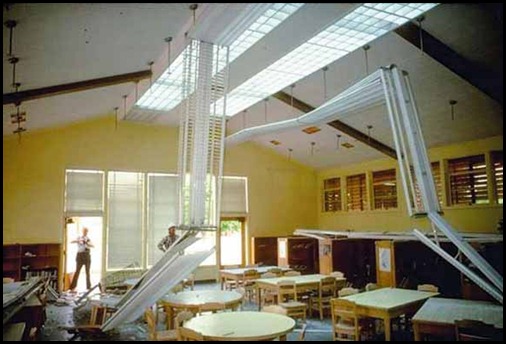
fig31
This is from a school near Nisqually. Our school only had a couple lights fall down, and was otherwise fine.
I tried to explain our harrowing tale to them, but even my best retelling didn’t convince them it was cooler than the Rapture.
vroomvroom
Well, I tried.
The 2001 Nisqually earthquake only rated a 6.8, with a depth of about 52km, and is an example of normal faulting in a subduction zone – the Juan de Fuca plate was bending (and stretching) as it was forced under the North American plate. This is possibly due to increased warmth near the mantle heating up the subducting plate, dehydrating it and making it more brittle - kind of like baked potato chips.
foc
A fault plane solution for the Nisqually earthquake. The little circles are dilatations, and the little stars are compression - so you can see how part of the plate extended, compressing the material to either side.
cap-lake-lspd7
A path near the State Capitol. One fellow looks depressed at the thought of all the work he's going to have to do. The other fellow looks like this is the coolest thing to ever happen - definitely a geologist.
Luckily, only one person died (as the result of a heart-attack) and 407 people were injured. It did cause significant damage to roadways near the epicenter (in the Olympia and Nisqually area.)
img026
Highway 101 - nobody really uses the right lane, do they?
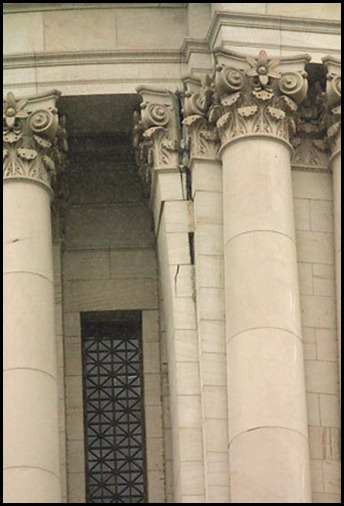
Additionally, it caused significant damage to buildings both in Olympia and Seattle – including causing a large crack in the dome of the Washington State Capitol in Olympia.
2014342999
The exterior of the State Capitol. You can see that some of the bricks are separating from the facade. The building was shut down for quite some time as it was examined for structural stability.
photo01
Looters run rampant in downtown Seattle.
These fellows actually just found a co-worker's purse amidst the wreckage of their van.

2014343028
 "Pssh, I've got nine lives, I ain't scared."
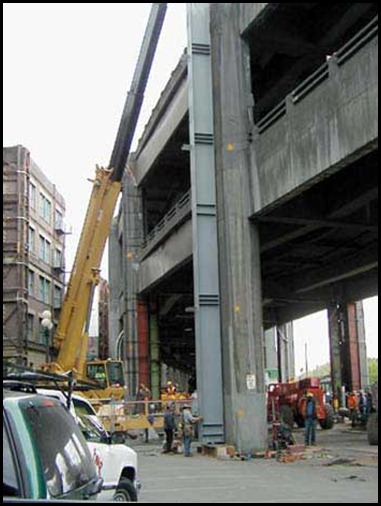
It also damaged the Alaska Way Viaduct in Seattle, which led to a decade of plans, negotiations, and general strum und drang about replacing it, as well as this terrifying simulation. Apparently, they’ve now begun construction on a replacement. The earthquake resulted in $3.5 million in repairs to the viaduct, and construction of a replacement/refurbishment/tunnel/etc. is projected to cost $3.1 billion. It’s money well spent, I think, because that sucker looks like a car-sandwich just waiting to happen.
DAMAGE_Repair4
Some fellows braving aftershocks to repair the Viaduct so people can tempt fate.
There were also spots of liquefaction and sand boils in both Olympia and Seattle. Liquefaction is pretty nifty, and luckily didn’t cause much damage in this earthquake. (Many portions of Seattle’s waterfront are built on fill – liquefaction could be a huge problem for those areas.)
nisq-delta-6
A sand boil in Olympia.
While much of the liquefaction seems to have been little sand boils, it also invaded basements. Additionally, there was a large mudslide in the Renton area, which also did significant property damage.
dsc00303
Worst sweeping job ever.
I’m really glad that I was able to experience a medium-sized earthquake, without my family suffering any damages, and without the region suffering many deaths. I do still kind of wish we had realized it was an earthquake when it was occurring – that would have been so much more terrifying and exciting! But it was still a very memorable experience.


In addition to the websites linked through the above photos, here are some websites with information on the Nisqually earthquake:
Some Observations of Geotechnical Aspects of the February 28, 2001, Nisqually Earthquake in Olympia, South Seattle, and Tacoma, Washington
Geodetic Information from Central Washington University
The Nisqually Earthquake Information Clearinghouse, housed by the University of Washington
GPS Analysis of Olympia Quake from Rensselaer Polytechnic Institute
The Pacific Seismic Network's Nisqually Earthquake Page
USGS's Preliminary Earthquake Report
Washington State Department of Natural Resource's Nisqually Earthquake Page
Identifying the Rupture Plane of the 2001 Nisqually, Washington, Earthquake
A Video Taken Inside Microsoft During the Earthquake
KOMO News Broadcast from February 28, 2001
Car image: http://bit.ly/x4x9RL

This video made me laugh so hard I cried. It's ridiculous!


Friday, November 11, 2011

Jurassic Lantern

As a kid, “Jurassic Park” gave me nightmares. I would lay in bed, and think about how a Tyrannosaurus could totally hide behind my parent’s rhododendron bush. The only consolation was that my bedroom had round doorknobs - and thus was Velociraptor-proof.

PB101190

Perhaps a Parasaurolophus doesn’t have “a six-inch retractable claw, like a razor, on the middle toe. He doesn't bother to bite your jugular like a lion, oh no … he slashes at you here or here … or maybe across the belly, spilling your intestines.”

PB101178

Parasaurolophus really isn’t the scariest dinosaur around, even in lantern-form.

But when I was staring at a pumpkin, trying to think of something geological to carve for this month’s Accretionary Wedge challenge , Parasaurolophus seemed fitting:

PB101186

Especially since I spent Halloween watching Jurassic Park and enjoying some chocolate stout – the intersection of youth & slightly-less-youth.

I hope everyone had an exciting Halloween, filled with (possibly prehistoric) undead (cloned) creatures!

Sunday, March 6, 2011

Accretionary Wedge #32: Carnival of Blogs

Ann at Ann's Musings on Geology & Other Things is hosting March’s Accretionary Wedge, with the special Mardi Gras theme of a parade of favorite geology pictures!

It’s always hard to pick a favorite geology picture, but this wintery Crater Lake panorama tops my list right now. Crater Lake is one of my favorite places, and it was exciting to visit in the winter! The perfect mirroring effect was particularly stunning. In person, the sky and water were the same color, making the caldera look like an arch in the sky.

Composite

Saturday, January 29, 2011

AW #30: The Moon is Made of Toasted Coconut.

The Accretionary Wedge #30 was a Geologic Bake Sale! Baking is one of my favorite hobbies, and I wanted to do something new and exciting for this challenge.

When I saw this recipe, inspiration struck. The flakes of coconut lay so lightly atop one another, as though they were gently supporting each other without actually touching…

P1250049

… which is exactly what happens on the moon!

Regolith is akin to soil on the Earth: it’s the layer of unconsolidated material over the bedrock. The moon’s regolith is composed of  bedrock pulverized by meteorites and “micrometeorites” – meteorites that are under a millimeter in size. Over the long life-span of the Moon, these micrometeorites have succeeded in completely altering its surface. (Just goes to show how concentrated effort over time can yield immense results!)

The top portion (3 – 5 m) of the regolith is composed of really fine-grained, loose particles. These sort of “float” on the surface: they are held together in layers by Van der Waal forces. (Van der Waal forces occur when charged molecules are very gently pulled toward oppositely charged molecules, and are very weak.) This is very similar to the uppermost, lightly held together layer of coconut.

The bottom portion of the regolith is more solid, and frequently referred to as the “megaregolith.” This is a layer of very fractured bedrock, 2 – 3 km thick on the highlands, and about 1 km thick on the maria. Here, it’s the more consolidated layer of coconut.

Much as Earth-soil has different varieties, the regolith has two different components: glass spherules and agglutinates. Glass spherules form when melted rock from a meteor impact solidifies in mid-flight, not having enough time to form a crystal structure. (Similar to how obsidian is formed very quickly from lava.) Agglutinates are glassy breccias composed of rock bits and vesicles containing gas from solar winds, all held together with rapidly melted rock.

Under all of that is the bedrock of the moon, anorthosite and basalt. I decided to have a simple basalt/brownie bedrock – this section of the moon is somewhere in a flood-basalt mare (or "sea”,) to account for it’s thin layer of megaregolith.


P1240007

These are the ingredients needed to create an edible Moonscape. Some of these were doubled, as I needed to make some extra bedrock, which I flavored with two packets of that Starbucks Via instant coffee. Additionally, I used 10 oz of coconut, and an extra splash of milk, to increase the bulk of my regolith.

P1240022

And this is the Moon, post-baking! Note how that regolith seems soft and fluffy.

P1240024

This is a futuristic moon bubble, to protect this patch of regolith from any wandering spacemen…

P1240005P1240008

… of which there were several, repeatedly! Colonizing in Moon lava tubes might be a better idea after all…


P1250033

After everything had a chance to cool, I set about to make the crater. (We’ll discuss actual crater formation in a minute!)

To do this, I punched a hole in the coconut slab, and set it atop the brownie bedrock layer. There was some minor excavation of that layer as well. Using bits of brownie, I constructed the central peak of the crater, and placed some fragmented bedrock inside the crater. Using the extra coconut slab, I carefully compiled a reverse layer of ejecta around the crater.

P1250039

To prepare the melt for the inside of the crater, I melted a Cookies and Crème bar in the microwave (not for too long or it burns!) and poured it into the crater. After engaging in a little careful destruction to create collapsed crater walls, the Moonscape was done!

P1250046

Here’s a close up of the side, giving a better look at the overturned regolith/ejecta layer, and the added bedrock.

CraterStratigraphy

(A simple line diagram of central peak craters is found here, in case the deliciousness of mine is distracting.)

When a meteorite impacts the moon, the ground is rapidly compressed downwards, away from the incoming meteorite. After the  meteorite impacts, this pressure is released, allowing the material to rapidly – and explosively – decompress, creating the crater.

When the crater floor decompresses, the bedrock under the crater rises up to create a central peak – if the crater is larger than about 50 km. (Craters larger than a couple hundred km in diameter are called impact basins, and develop both a central peak and 1+ upraised rings inside the basic. Craters smaller than 50 km are called simple craters, and lack the central peak entirely.)

When the compressed regolith rapidly expands, it blows the surrounding regolith away from the crater, creating a ring of over-turned stratigraphy. Because of this phenomenon, the older and deeper material gets thrown farthest from the center of the crater. This is visible in the layer of brownie bedrock atop the ejected coconut.

Frequently, the bedrock in the crater floor is fractured, and magma seeps through to the surface, creating a puddle of magma-cemented breccia, sometimes referred to as “melt” – or, in this case, the melted chocolate. Additionally, the walls of medium and large craters frequently suffer from landslides, due to their tall, steep walls.


Now, there are two scientific inaccuracies in this edible diagram: 1) there should be a larger cloud of finer ejecta, and 2) for the bedrock to be so exposed, the crater should be larger in diameter.

But, space constraints aside, it was a fairly accurate model, and tasty to boot!


(My main references for this were my notes from a planetary geology class I took a couple summers ago. Since those aren't online, I've merely linked to some informative wikipedia pages. Say what you will about wikipedia's accuracy, it's still a good starting point!)

Tuesday, November 30, 2010

The Upsides and Downsides of Mountains

I’ve lived in Western Washington for a total of twenty-one years, so it’s really easy for me to answer this month’s Accretionary Wedge (#29!) as posed by Ann at Ann's Musings on Geology & Other Things: "What Geological features about the area you call 'home' do you love? and what do you not like?"

Washington can be divided very roughly into thirds: Eastern Washington, home to the Missoula Flood-carved Columbia River Flood Basalts; Western Washington, with thick glacial deposits and steep stratovolcanoes in the Cascade Mountains; and the Olympic Penninsula, which is an accretionary wedge, with the uplifted Olympic Mountains.

My favorite geological features are the volcanoes. These result from the subduction of the Juan de Fuca plate beneath the North American plate:
Map, Plate Tectonics and the Cascade Range, [18K,GIF]

Cascades Volcano Observatory

IMGP1168

Mt. Rainier

P1180086

Mt. St. Helens

P1160735

Mt. Adams


Now, my least favorite geological features of Western Washington are also the Cascades, because they help cause the massive, constant amounts of rain.

sequimwa.com

The Olympics create a rain shadow, but they aren’t so high that all the moisture condenses and falls: the rest is carried over the Puget Sound. As it does so, it picks up more moisture, which then condenses as it rises over the Cascades, dropping all over Western Washington.

That’s why it rains 365 days out of the year (or at least feels like it!)

Thus, my Theory of Seattle: the rain nourishes the trees and shrubbery, which grows profusely and blocks out the light. Between the rain and the trees, everyone wants to stay indoors – thus, the major IT industry begins. Between the masses of commuters and the nasty dim weather, rush hour runs rampant. Since everyone codes late into the night and has to get up early to beat the traffic, the immense coffee culture is started. Thus, the population has a Vitamin D deficiency, stares at computers constantly, is always struck in traffic, and gets regularly strung out on coffee, resulting in perpetual depression and tweakiness. Thus leading to the reign of 90s grunge music, which also contributes to the high suicide rate.

That’s my theory, at least. And I’m sticking to it.

P1190460

I’ll be honest: I’ve had my fill of the dreary rain and endless rush hour.

So, I’m going to study Geology at Boise State University next year!

Saturday, October 30, 2010

Accretionary Wedge 28: Familial Bookcase-crop

This Accretionary Wedge, hosted at Research at a snail's pace, is focused on desk-crops. Normally, this would be very exciting – I have a healthy assortment of rocks. But, unfortunately, I put all my rocks in my storage unit when I moved to Idaho for the summer.

I only remembered about this Accretionary Wedge once I arrived in Oregon with four boxes, none of them containing rocks. Luckily, before I went to Phoenix last week, I was helping clean a bookshelf at my parent’s house in Washington, and happened to take some pictures of my mother’s minerals.

My mother (a painter of caves – seriously!) has a soft spot for colorful minerals and rocks. These are actually examples from her stash of minerals inherited from my grandfather, who was into rock-hounding. My mum has some great childhood stories from these trips, including “Terrifying Mine Experiences Involving Cupcakes,” and “Innocent Encounters with Canadian Mounties.”

I haven’t studied mineralogy much yet, so I’m mainly going to reference that bastion of scientific accuracy: wikipedia.

P1130011

This Death Tribble is a piece of dogtooth spar, or dogtooth calcite. This usually consists of acute scalenohedrons: twelve triangular faces roughly making up scalene triangles.  They need standing water to allow them to grow, and so are frequently found in limestone caves. (My grandfather, I’m sure, found this in a rock shop – he wasn’t a caver, much less a cave-vandal.)

P1130019

The only spooky thing about orpiment is that it’s a highly toxic cocktail of arsenic and sulfide, originating through the rapid solidification of hot gases at fumaroles, hot springs, and hydrothermal veins. It can also occur as the decay byproduct of realgar, a mineral of a similar composition that is frequently also found in conjunction with orpiment. (I’m wondering if realgar is in this sample, based on its appearance in google images.) Orpiment has historically been used for poision, medicine, and paint pigment; its present uses include semiconductors, firework pigments, and as an ingredient in Indian depilatories. (Perhaps: “Extreme Hair Remover: Now with Arsenic!” ?)