Best of...

Showing posts with label photography. Show all posts

Sunday, April 10, 2011

Back East, Pt I: Baltimore & Atlanta

P3170069

I recently spent a few weeks visiting relatives back on the East coast. While that’s not really appropriate fodder for this blog, I also saw some fantastic places that I took altogether too many photos of.

2,500 photos too many.P3170060I had never been to the East Coast before, and was most impressed with the great architecture, and the sheer quantity of it. Our first stop was Johns Hopkins University, to visit my sister and wait for her to finish classes, and it didn’t disappoint in  architecture either. IMGP1903_thumb2

My sister took us around to her favorite places on campus, including the building that houses a robot surgeon, and her favorite lecture halls.

P3170084_thumb1

After that, we visited the Inner Harbor, where we ate tapas, bought shoes, and touched the Chesapeake Bay/Atlantic Ocean.  We also had some strange wafer-like cookie covered with frosting/fudge/ganache called a Berger. These are a regional specialty, but were a little too sweet for even my sweet tooth.

P3190150_thumb1

I also tried octopus, which was basically like gnawing on a giant piece of whale blubber. It was good, as long as you didn’t think about the little crispy suckers.

P3180018

While in Baltimore, we stayed at the Baltimore Hostel, a charming, quiet hostel in a fancy old row-house. It was close to the harbor, and to some nice restaurants, so it made a good home base.


As soon as my sister was done with her classes, we jet-setted off to Atlanta. There, we spent about four days with one of my great-aunts, who is quite ill with Parkinson's. It was stressful being there, but it was really good to visit her, meet a few other family members, and finish up a few school assignments. It would have been nice to stay longer, but we had another aunt to visit before my sister’s break was over.

P3220284_thumb1

My great-aunt was quite insistent that we go see Atlanta, so we spent an afternoon in the city. We started out at by visiting the Cyclorama, a circular painting depicting the Battle of Atlanta, which, if lain flat, would cover an entire football field. You sit on a stage inside the painting, and then the stage rotates slowly as a guide points out important facets of the painting. In the lobby of the Cyclorama sits the “Texas",” a steam locomotive involved in “The Great Locomotive Chase” of the Civil War. (The steam engines in this chase typically averaged a whopping 15 mph.)

P3220315_thumb1

After that, we really wanted to see an antebellum house, and managed to find one that was still open – the Herndon Home. It turned out that the Herdon Home isn’t just a nice house, but also the home of Atlanta’s first black millionare, Alonzo Herndon. Alonzo Herndon was born into slavery, but became trained as a barber, and eventually opened up his own shop. He then proceeded to become involved in real estate, and then bought what became Atlanta Life Insurance Company. The house was mainly furnished by his first wife, an actress and elocution teacher at Atlanta University, who had great taste in home design. I had honestly just been looking for a pretty house, but the history behind the Herndon Home made it one of my favorite discoveries of our trip.

After that, we headed off to Virginia and Washington D.C., which really warrants a post in of itself!

Thursday, March 24, 2011

Scenic South Idaho

When I tell people that I moved to Idaho, they react in a couple different ways: enthusiasm about the region’s beauty, or badly veiled confusion and disgust.

Sometimes, instead of waxing poetic about rocks and getting eye-rolls, I opt for simplicity and just mention sunsets, big skies, and weird plants.

P1240210

P1240685

P1240679

P1240107

IMG_2628

IMG_2722

IMG_2271

Wednesday, March 23, 2011

Yellowstone Pictures, Pt. II

I’m over on the east coast, doing some family visits, and thought I’d use the occasion to post some photos from this past summer/fall, that have heretofore been unpublished. This first set is from a trip to Yellowstone – there are a few more pictures here.P1240403

The entrance sign near West Yellowstone, WY. (Which has an incredible 4th of July fireworks show!)

DSCF5084

Mud pots! (I bet that’d make a great face mask… not that I advise trying!)

DSCF5101

The view overlooking one of the geyser boardwalks. It was really comforting to think about so many people enjoying and learning about geology!

DSCF5113

Spasm Geyser.

DSCF5178

Near Prismatic Spring. (I overheard a private tour guide saying that the best viewpoint for Prismatic Spring was actually the parking lot for Fairy Falls, but we didn’t get a chance to check out that tip.)

DSCF5204

Sunset Lake.

P1240418

The Old Faithful Inn’s interior is spectacular! (And the ice-cream is very good also.)

P1240427

Old Faithful Geyser.

P1240450

Avoca Spring, possibly.

P1240474

Hint: Madison campground has no showers - which means that you can frequently get a site without a reservation!

Another hint: Getting a back-country hiking/camping permit is pretty easy, but watching the Bear Country Camping video does take some time. As does buying the required bear spray and ropes for hanging food. Oh, and they like it if you research trails in advance, instead of showing up the day of and asking for whatever slots are open. We got a permit, but by the time we got to the trailhead, realized we couldn’t get to camp before sunset, when the bears come out to rummage through your groceries, and the rangers require you to be off the trails.

Another hint: advance planning is probably a good idea when visiting a major tourist attraction! We had a good time, but that would have made it a great time.

P1240451

(Another note for unprepared/impromptu travellers: if want to hike the Grand Canyon, but lack the permit/reservations, you can sometimes get cancellations the morning of! My family’s actually had that work out twice. You definitely want to be in sufficient physical condition, however!)

Sunday, March 6, 2011

Accretionary Wedge #32: Carnival of Blogs

Ann at Ann's Musings on Geology & Other Things is hosting March’s Accretionary Wedge, with the special Mardi Gras theme of a parade of favorite geology pictures!

It’s always hard to pick a favorite geology picture, but this wintery Crater Lake panorama tops my list right now. Crater Lake is one of my favorite places, and it was exciting to visit in the winter! The perfect mirroring effect was particularly stunning. In person, the sky and water were the same color, making the caldera look like an arch in the sky.

Composite

Wednesday, February 23, 2011

Caving in Montana: Crystals Galore

These are well-known caves that are publically accessible with a permit. If you would like more information, or would like to view any of my site-specific references, please feel free to send me an email at helena.heliotrope at gmail.com. If you’d like to visit the caves, please contact the BLM Field Office in Cody at 307-578-5900, and ask about their caves!
IMGP3484 In the fall of 2009, I got to go on an epic caving weekend near the Montana-Wyoming border. I talked briefly about some interesting chert nodules here, but I was honestly holding out on the best stuff: the formations.
The caves here are formed in the limestones and dolomites of the Madison group. These rocks formed between 360 to 325 million years ago, in the Mississippian, when a relatively tranquil, shallow sea covered the area. Like most seas, this one was filled with small organisms that had calcium shells or skeletons (such as corals or amoeboids.) When these organisms died, their decaying corpses were slowly compressed into limestone. Above the limestone lies a layer of reddish sandstone called the Amsden laid down in the Pennsylvanian, visible as the red streak in the above picture. After undergoing a sequence of uplift and subsidence, it was uplifted to its current level during the Laramide orogeny, about 70 million years ago. This created joints in the limestone that would someday become caves.
(It’s a really structurally interesting area – some of the nearby mountains are uplifted in a giant anticline, while the ones in the above picture are fault blocks that were tilted upwards.)
The Madison group stretches from South Dakota to eastern Idaho, and from Canada down into Colorado and Arizona, although the name differs regionally. Since limestone is very soluble, it’s chock-a-block with caves, including Lewis and Clark Caverns in Montana. Because of its solubility, it forms a very important aquifer, and has produced a prodigious amount of oil – over 1,400,000,000 barrels. (Pretty impressive for a bunch of dead sea critters!)IMGP3506These caves were eroded as the basin lay beneath the water table, in a process called phreatic erosion. Phreatic erosion occurs as the water flows through cracks and joints, eroding passages through the limestone. This passageways travel in all directions: the above photo shows a vertical, cream colored passage cutting through different bedding planes. Additionally, we saw some collapse along bedding planes, which created some fantastic flat roofs, visible here in the greyish section. Dating caves can be difficult (much like men), however some ash found in these caves is from an Yellowstone eruption 640 thousand years ago.
(I apologize for the poor picture – it’s quite difficult to take decent photos of large cave rooms without secondary light sources.)
IMGP3586This is a trace fossil we found on one of the bedding plane ceilings – it’s where a sea creature was burrowing, or eating, or squirming along. (The paleontologist on the trip provided some more details, but I’ve unfortunately forgotten.) I had never seen a fossil in the wild before, so this was one of the trip’s highlights.
The first cave we went to is the most challenging cave I’ve been in so far, despite being entirely horizontal. The entrance is through a 100’ long crawlway – which sometimes is only 15” tall. (I definitely got stuck a couple times!) The floor of this crawlway is thickly coated with radon-laden dust: to avoid developing radioactive cavers, the BLM limits the time you can spend in the cave each year. We wore dust masks, to cut down on the amount of junk we inhaled, but that only served to make me more claustrophobic.  This was even more heightened by the heat – it was the warmest cave I’ve ever been in. It was a pretty rough beginning, but we were richly rewarded for all that effort with masses and masses of my favorite formation – helictites.
I didn’t have my camera that day, but I did the next day, when we visited the second cave. The day of this trip, snow was predicted, so we only spent the morning underground. (The road to the caves requires a 4wd vehicle generally, but is reportedly impassable in bad weather.) Luckily, as we ascended out of the cave right as the snow began falling, and made it to paved roads just in time.
IMGP3529The caves have a wide variety of calcite formations, including helictites, rafts, and some really large cave popcorn. Additionally, they have gypsum flowers and crusts, epsomite crystal curls, and aragonite needles. These all form near each other, making for some truly impressive photographs.
IMGP3514IMGP3523IMGP3555IMGP3571IMGP3535IMGP3588This last photograph is an interesting chunk of yellow and red crystal crust that was forming in a hole in the ground. I still don’t know what it is…
IMGP3556This is the underside of a rock, absolutely encrusted with black crystals.
IMGP3470As we headed back to civilization, there was an antelope hanging out, clueless about what lay beneath its small cloven hoofs.

Tuesday, January 11, 2011

Two Whirlwind Weeks

Two weeks ago, I decided to move to Boise. I was accepted into Boise State University in early December, but financial matters kept waffling the decision until immediately before the New Year.

PC210077

Since that decision, life has gotten pretty wild. There was a pretty epic cousins sleepover, consisting of myself and four teenagers all sleeping in my parent’s living room. (This basically prompted a regression into the depths of childhood.) There were two New Year’s parties, one of which may have involved bottom shelf booze. There was an excessive amount of detail-hammering-out in mundane preparation for the move.

Then there was the move itself, which was honestly the most painful road-trip I’ve ever been on. It began with yowling cats, and ended with driving snow. It was the longest 500 miles I’ve ever driven.

Now I’m settling into my new place in Boise, trying to get a driver’s license, looking for a job, and registering for classes! I got an introductory geophysics class, and an anthropology class, and am very excited to begin classes next week!

PC240167

Immediately before the move, I helped my sister shoot a video promoting the John Hopkins 4K for Cancer. This summer, she’s going to be riding her bicycle from Baltimore to Seattle, raising money for cancer research and volunteering with cancer patients along the way. She’s a molecular and cellular biology undergraduate student at John Hopkins, and an avid cyclist. She just started a blog chronicling her training, and eventually her ride, at rosemary4k4cancer.tumblr.com.

It’s been some time since I did film editing, so it’s taking longer than expected. But as soon as it’s done, I’ll post it here!

After all, how can you say no to claymation cellular replication?

Wednesday, November 3, 2010

A Couple Nice Eastern Washington Pictures

A few weeks ago, I spent a weekend near Prosser, WA with my parents and their friends. This was their annual bicycle-riding and wine-tasting weekend, so most of my pictures feature middle-aged folks in spandex. Much as I’ve become desensitized to such retinal injury, it seems rude to inflict it upon the internet. I did take some decent travel photos, however:

P1160088

P1170171P1170104

The last one shows some hop trellises. Washington state produces much of the world’s hops, believe it or not.

Monday, October 4, 2010

Stalagmite: definitely not limestone.


P1250097

In a lava cave roof, hot gases boil and push molten lava through cracks in the roof’s cooled crust. This lava can spooge out of its stalactite and drop to the ground, creating a stalagmite like this. This formation has a really nice metallic glaze to it, and I saw it in a cave near Bend, OR.

Wednesday, May 19, 2010

Jordan Craters

Unfortunately, my post on Mt. St. Helens isn't quite ready yet - I spent yesterday going to a lecture on geomorphology on Mars at the Northwest Geological Society in Seattle, and have a big test tomorrow to study for. (Those lectures make my month, and this one was really great. And an added perk: the school pays for our gas and the fancy buffet dinner. Swanky!)
In it's stead, here are some pictures from Jordan Craters, a small volcanic area in Eastern Oregon.

"The 27-square mile olivine basalt lava flow is estimated to be between 4000 and 9000 years old, based on the degree of lichen development on the rocks. An 18-acre flow within the field is thought to be less than 100 years old because not even lichens have begun to colonize."

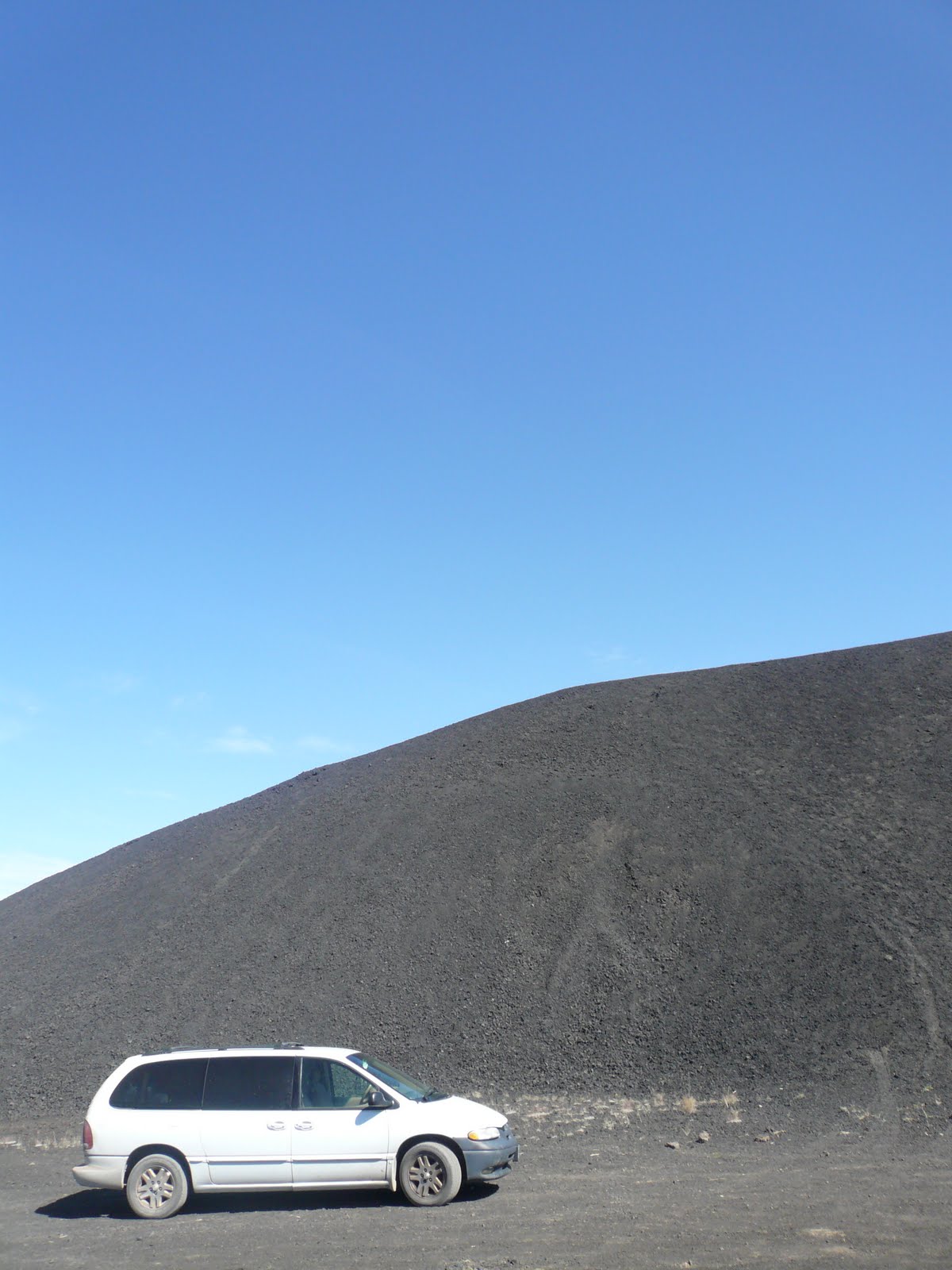
It's fairly petite, as lava fields go, but really cute. (Bonus: the surrounding countryside is gorgeous.) This picture encompasses about half of the lava field. The foreground is a line of spatter cones. In the mid-ground, you can see the largest of the cinder cones - Coffee Pot Crater. The background are the lava flows themselves.

(Adapted from: Bruce R. Otto and Dana A. Hutchison, The Geology of Jordan Craters, Malheur County, Oregon, The Ore Bin, Vol. 39, No. 8, August 1977)

Coffee Pot Crater, from the rim. The detached wall block is on the right.

These are the reddest scoria I've ever seen - it really resembled raw hamburger at times. In other places, the scoria is a dark black. I hadn't seen this concentration of scoria before, but since it's a cinder cone, scoria is everywhere! It makes climbing out of the crater a bit tortuous.

This is the detached wall block, seen from the side.

The crater floor.


This is the side wall of the crater, with some stratigraphy present.

FYI: There are signs saying that all wheel drive is necessary, but if you're an awesome driver like me, the minivan'll make it.

View Larger Map
Unfortunately, we didn't get to explore the whole lava field, because I had to drop my mum off in Boise because her uncle died unexpectedly. After that, the stalwart minivan died in the deserts of Nevada. But that's another story.